Technical decisions:
An overlay layer, not a window
Hyprwall draws itself as a Wayland layer-shell surface on the overlay layer, using smithay-client-toolkit. Instead of being just another window of the compositor, it’s a layer that covers the screen with exclusive keyboard interactivity, so the selector appears on top of everything and captures the arrow keys without fighting the rest of the environment.
Elm architecture
The state lives under a Model–Msg–Cmd pattern: Wayland events are translated into messages, a pure update function decides how the state changes and which effects to fire, and the resulting commands (redraw, apply wallpaper, exit) run separately. The concrete advantage is that all the navigation and selection logic stays free of Wayland and can be tested with pure functions, without bringing up a compositor.
Custom software rendering
There’s no GPU here: each frame is rasterized by hand onto a shared-memory buffer with tiny-skia, and the label text is drawn glyph by glyph with fontdue, including ellipsis clipping when a name doesn’t fit. The pipeline is split into two stages: first a scene is built —a resolution-independent list of drawing commands— and then a rasterizer paints it applying the scale factor. That keeps HiDPI support in a single place and leaves the scene construction easy to test.
Carousel with a central focus
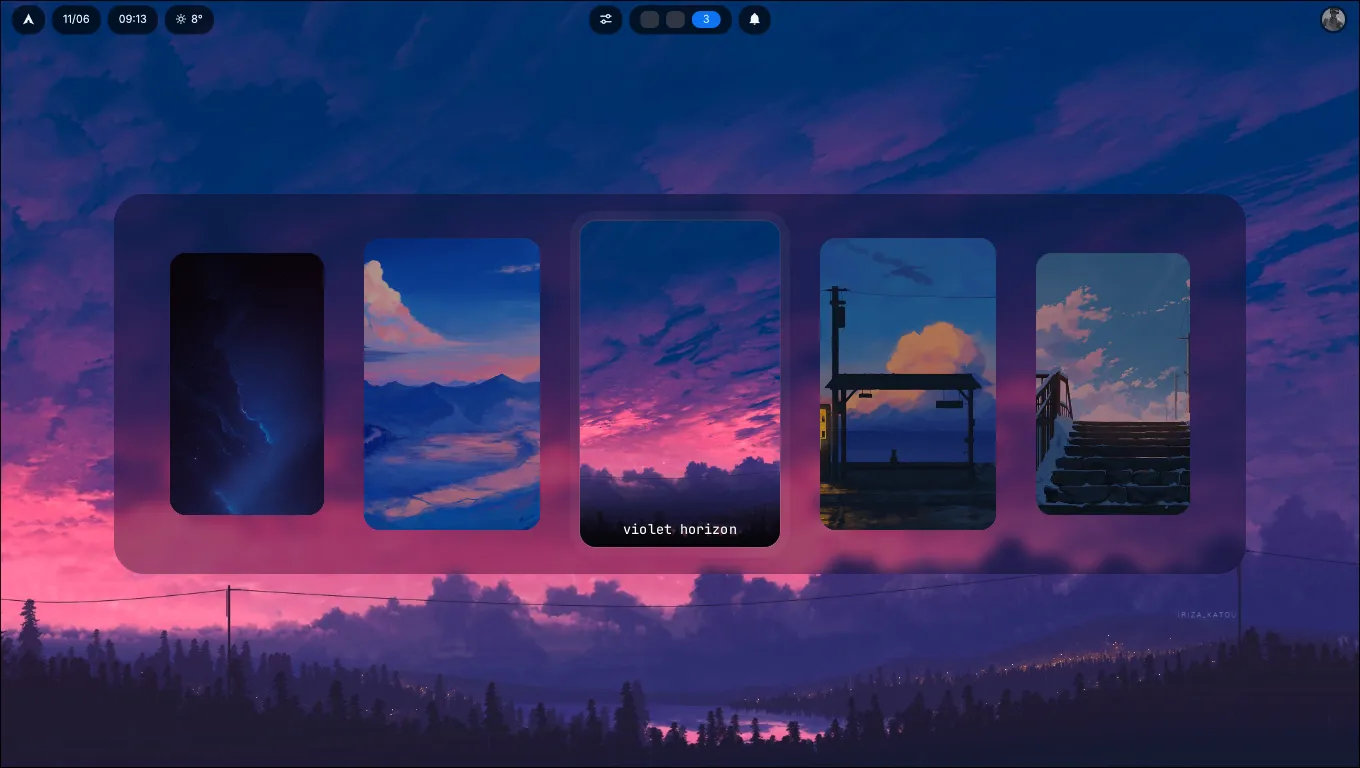
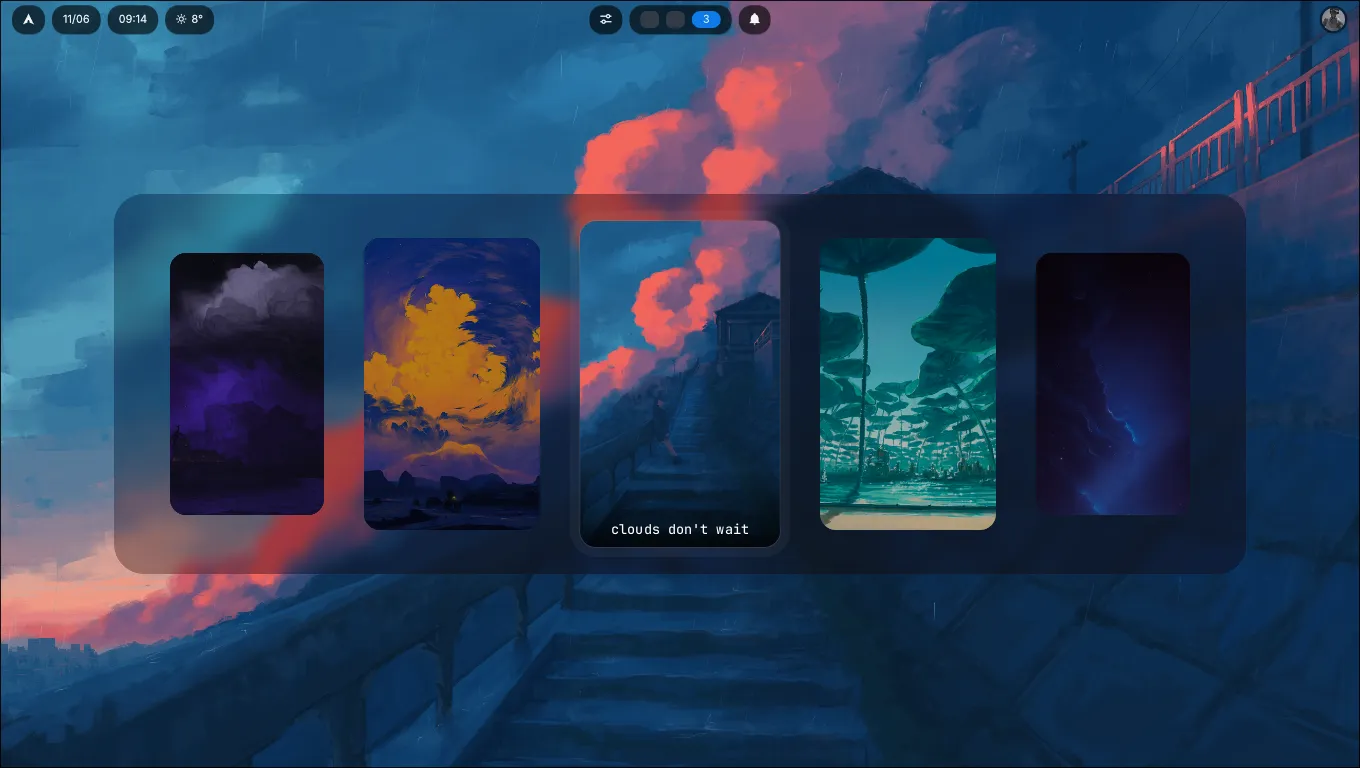
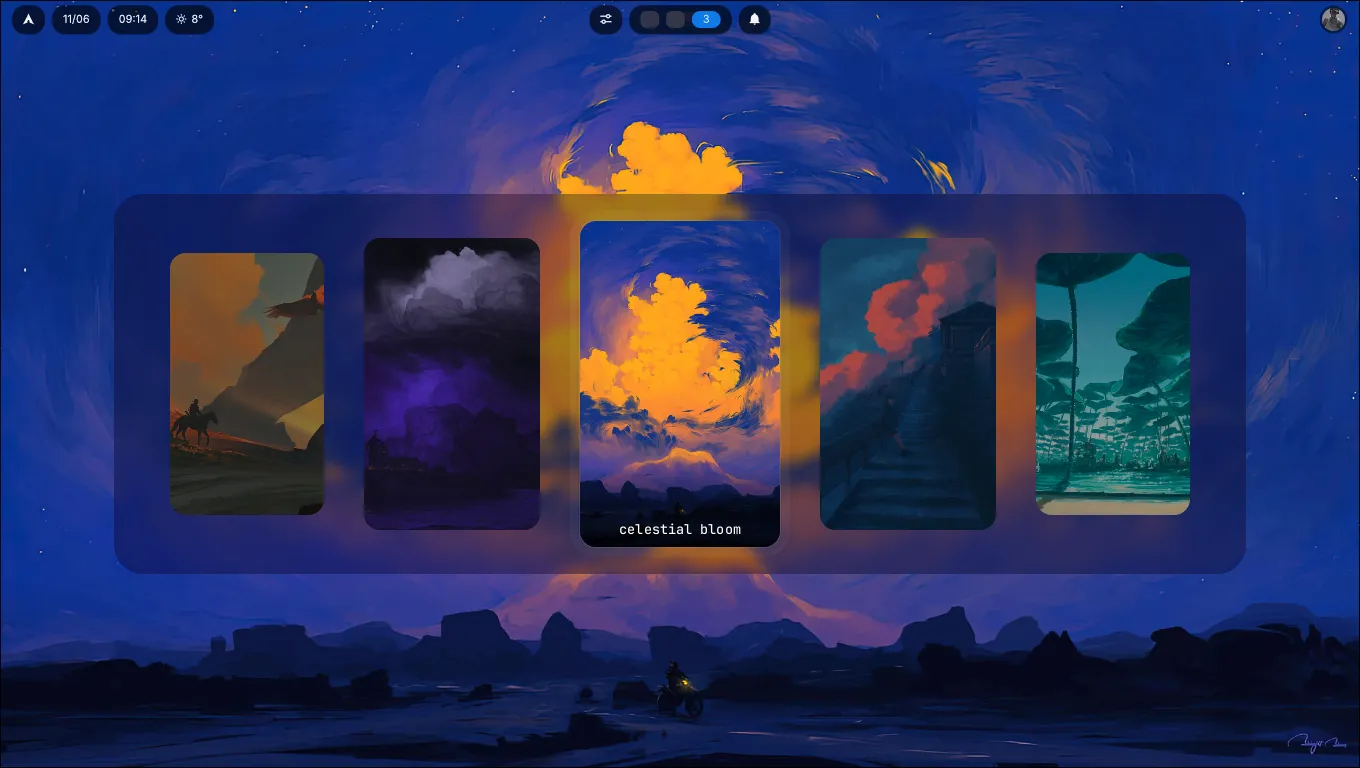
The layout places the selected wallpaper large and centered, and the rest spread out to the sides, shrinking with distance and wrapping around circularly. Only the cards that fit on screen are computed. The hit testing for the click comes from the same layout, so what you see and what you can click never get out of sync.
Parallel loading
On startup, the wallpapers in the directory are decoded and reduced to thumbnails in parallel with rayon, preserving the original alphabetical order even though they finish in any order. The images are decoded only once at a bounded size, not when resolving each frame.
Applying the wallpaper
To set the background, hyprwall tries awww, swww and hyprctl hyprpaper in a cascade, starting the corresponding daemon if needed and waiting for its socket to appear. It works with whatever tool you already have installed instead of imposing one. After applying, it remembers the current wallpaper in a cache and leaves a symlink — which is exactly where hyprcolor and hyprbar read the active background from to recolor the rest of the desktop.
Tests
The pure logic —the state reducer, the picker navigation, the scene construction— has unit test coverage: that the arrows wrap around, that a click changes the selection and fires the application, that the scene emits the panel first and then the cards. The part that touches Wayland is left as a thin translation layer with no decisions of its own, so it doesn’t need a compositor to be tested.
Current status
It works end to end: it scans the directory, shows the carousel, navigates with keyboard or mouse and applies the chosen wallpaper. It’s the piece that closes the ecosystem —it picks the background that hyprcolor turns into a palette and that hyprbar reflects in its accent color.